
Why Does Concrete Polishing Fail?
Concrete polishing can fail even when the floor looks suitable for the job at first. Common problems include uneven gloss, visible scratches, patchy color, inconsistent aggregate exposure, and a surface that never develops the expected finish. These issues often begin before the polishing stage. The condition of the concrete, the preparation work, the grinding sequence, and the choice of tooling all affect the final result. Identifying where the process went wrong is more effective than trying to correct every defect with additional polishing.
Inadequate grinding is a frequent cause of poor polishing results. Each grinding stage needs to remove the scratches left by the previous stage before the contractor moves to a finer grit. If the initial grinding leaves deep marks, or if a grit stage is skipped or rushed, those scratches may remain visible after polishing. Using finer diamond polishing pads will not necessarily remove deep scratches efficiently. Contractors should inspect the floor between stages and confirm that the previous scratch pattern has been adequately refined before moving forward.
Tool selection also affects how the concrete responds during grinding. Metal diamond grinding pads that are too hard-bonded for the floor may struggle to expose fresh diamonds, while a bond that is too soft can wear away excessively under unsuitable conditions. Diamond grit, segment design, aggregate abrasiveness, and grinder settings all influence material removal and scratch consistency. On particularly hard concrete, a suitable soft-bond metal tool is often a good starting point, although the right combination should be confirmed through actual grinding performance rather than concrete hardness alone.
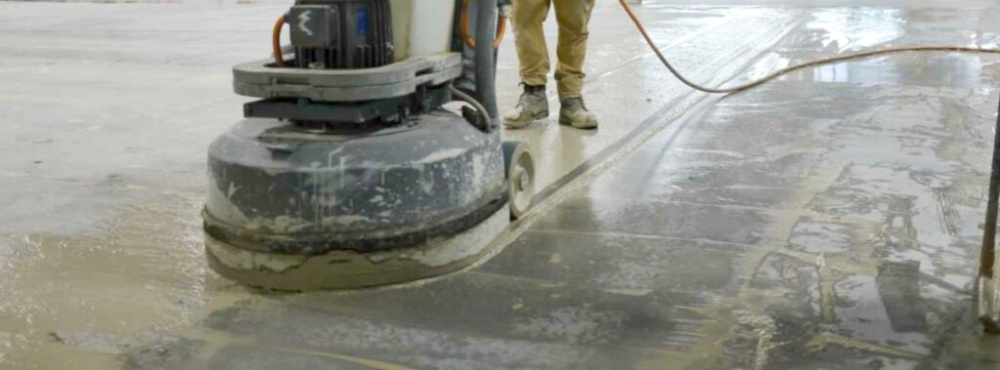
The concrete itself can create challenges that tooling cannot completely eliminate. Variations in hardness, aggregate distribution, previous repairs, surface contamination, and porosity may cause different areas to grind or polish at different rates. A floor with patching compounds or inconsistent repairs may develop visible differences in color and gloss, even when the grinding sequence is followed carefully. Before work begins, contractors should inspect the slab, identify repaired or damaged areas, and discuss realistic expectations for aggregate exposure and appearance. Polishing improves the surface, but it cannot make naturally inconsistent concrete look perfectly uniform in every case.
Problems can also arise during densification and final polishing. A concrete densifier must be applied according to the product instructions and the condition of the floor. Residue left on the surface, inconsistent work across different sections, or moving to the final polishing stages before the concrete is sufficiently refined may contribute to haze or uneven gloss. When the floor needs further refinement, concrete floor polishing pads should be selected according to the existing scratch pattern and the finish required. The most effective response to a failed polish is to identify the stage that introduced the defect and correct it where possible. A consistent grinding sequence, suitable tooling, and careful inspection at each stage are essential for achieving a high-quality polished concrete finish. The final appearance also depends on the condition and consistency of the existing concrete.
- Newsletter
- Join our community
- Company Info
- Feedback Customer Reviews About Us Contact Us Blog Help Center
- User Center
- Forget Password My Orders Tracking Order My Account Register
- Payment & Shipping
- Customs & Taxes Locations We Ship To Shipping Methods Payment Methods
- Company Policies
- Return Policy Privacy Policy Terms of Use Infringement Policy